
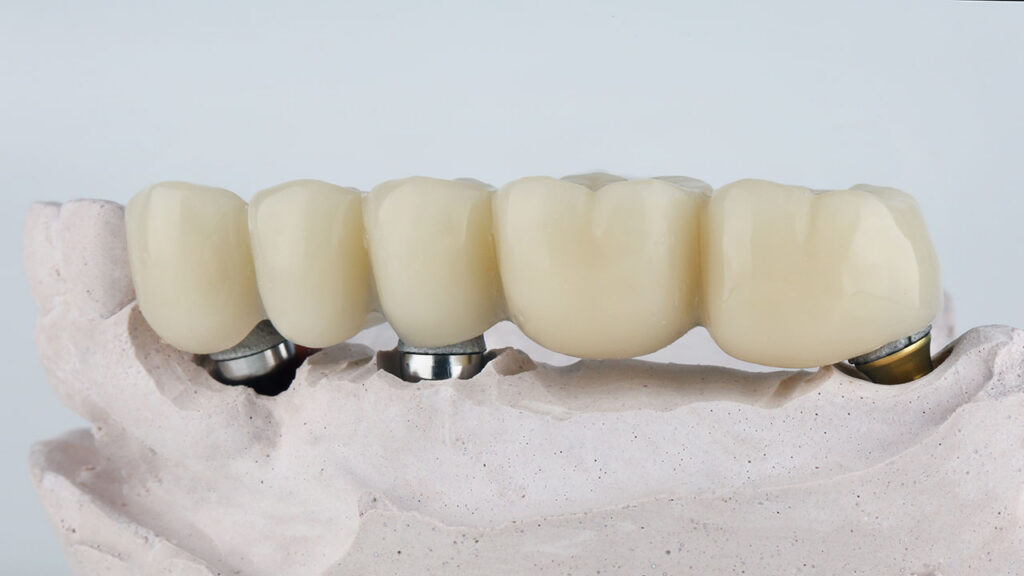
Missing several teeth in a row can affect chewing, speech, bite balance, and the way neighboring teeth fit together. An implant bridge, also called an implant-supported bridge, can replace multiple missing teeth by using dental implants as the foundation instead of relying on natural teeth at each end of the gap.
At MB Dental at Heights, patients can be evaluated for implant-supported tooth replacement when several adjacent teeth are missing or cannot be predictably restored. Because the practice also provides restorative dentistry, the dentist can compare an implant bridge with options such as a traditional bridge, removable partial denture, or individual dental implants based on the location of the missing teeth, available bone, bite, oral health, and treatment goals.
What Is an Implant Bridge?
An implant bridge is a connected dental restoration that replaces two or more missing teeth and is supported by dental implants. The implants are placed in selected positions within the jawbone, then the bridge is attached after the implants have reached the appropriate stage of healing and stability.
The key difference is where the support comes from. A traditional dental bridge usually relies on natural teeth next to the gap. Those teeth are prepared for crowns that hold the replacement tooth or teeth between them. An implant bridge receives its primary support from implants placed in the jaw.
Because one implant does not necessarily need to be placed for every missing tooth, an implant-supported bridge can sometimes replace several adjacent teeth with fewer implant posts than the number of teeth being restored. The exact number depends on the length of the space, bone availability, bite forces, implant positions, and the design of the final restoration.
When Might an Implant Bridge Be Considered?
An implant bridge may be discussed when a patient is missing several neighboring teeth. It can also be considered when multiple teeth in one area have a poor prognosis and are expected to require removal.
Common situations may include:
- Two or more adjacent missing teeth
- A long gap where a traditional bridge would require extensive support from natural teeth
- Healthy neighboring teeth that a patient would prefer not to prepare for crowns
- Missing back teeth where there is no natural tooth behind the space to support a conventional bridge
- A removable partial denture that the patient would like to replace with a fixed option
- Multiple damaged teeth that require extraction and replacement
However, an implant bridge is not automatically the best choice for every space. The dentist must evaluate the condition of remaining teeth, the jawbone, gum health, restorative space, and the way the teeth come together during biting.
Implant Bridge Versus a Traditional Dental Bridge
Both treatments can replace multiple missing teeth, but they use different foundations.
A traditional bridge is supported by natural teeth. The teeth on either side of the missing space are usually reshaped so crowns can fit over them. The replacement tooth or teeth are connected between those crowns.
An implant bridge is supported by dental implants. Therefore, healthy neighboring teeth may not need to be reduced simply to hold the bridge. This can be especially appealing when the teeth beside the gap are intact and otherwise healthy.
On the other hand, a traditional bridge does not require implant surgery and may be completed on a different timeline. It can also be appropriate when the supporting teeth already need crowns for restorative reasons.
The decision is based on more than whether implants are available. It should consider the condition of neighboring teeth, bone support, treatment time, maintenance, anatomy, and the patient’s preferences.
Implant Bridge Versus Individual Dental Implants
Another question is whether every missing tooth should receive its own implant. In some areas, individual implants may be appropriate. In others, an implant-supported bridge can replace several teeth using a strategically planned number of implants.
For example, a three-tooth space does not always require three separate implant posts. Depending on the bite and anatomy, implants may be placed at selected positions to support a connected bridge. However, the exact design must be determined clinically.
Using a bridge can reduce the number of implant sites while still providing fixed tooth replacement. At the same time, connected restorations have their own cleaning requirements because patients need to clean underneath the replacement teeth and around each implant.
How Is an Implant Bridge Planned?
Treatment begins with a comprehensive dental examination. The dentist evaluates the missing-tooth area, remaining teeth, gums, bite, and medical history. Imaging is also important because the implants must be positioned within available bone while avoiding important anatomical structures.
Planning is both surgical and restorative. The dentist does not simply look for places where implants can fit. The planned tooth positions, bridge shape, bite contacts, and cleaning access influence where implants should ideally be placed.
If teeth need to be removed, those extractions may become part of the treatment sequence. If bone volume is limited, grafting may be recommended before or during implant treatment depending on the case.
The goal is to create a foundation that supports the final implant bridge in a way that is stable, cleanable, functional, and appropriate for the patient’s anatomy.
What Happens During the Implant Bridge Process?
Although treatment varies, most implant bridge cases involve several stages.
Evaluation and Records
The dentist examines the area and obtains the records needed to plan implant positions and the final restoration. This is also when alternative treatments can be discussed.
Implant Placement
The dental implants are placed in the jaw at the planned locations. Local anesthesia is commonly used, and additional comfort options may be considered depending on the procedure and patient needs.
Healing
The implants generally need time to become integrated and stable within the surrounding bone. The healing period varies based on the location, bone condition, implant stability, and whether other procedures were completed at the same time.
Restorative Phase
Once the implants are ready, digital scans or impressions can be used to create the implant bridge. The restoration is designed to replace the missing teeth while fitting the bite and neighboring teeth.
Final Placement
The completed bridge is attached to the implants. The dentist evaluates fit, bite, appearance, and cleaning access. Follow-up appointments help ensure that the tissues and restoration are adapting appropriately.
Benefits of an Implant Bridge
For patients with several missing teeth, an implant bridge can offer a combination of fixed tooth replacement and implant-based support.
- Replaces multiple teeth: A connected restoration can fill a larger gap without requiring one implant for every missing tooth in every case.
- Uses implants for support: The bridge is anchored to dental implants rather than depending solely on neighboring natural teeth.
- May preserve healthy adjacent teeth: Natural teeth next to the gap may not need to be reduced for bridge crowns when implant support is used.
- Fixed restoration: An implant bridge generally stays in place rather than being removed at home like a removable partial denture.
- Supports chewing function: A stable restoration can help restore contact in areas where several teeth are missing.
- Helps maintain tooth spacing: Replacing missing teeth can help reduce unwanted shifting of neighboring teeth into an open space.
- Custom appearance: The replacement teeth can be designed to coordinate with the surrounding smile in shape, size, and shade.
Can an Implant Bridge Replace Missing Back Teeth?
Yes, implant-supported bridges are often considered when several posterior teeth are missing. This can be particularly useful when there is no natural tooth at the back of the gap to support a traditional bridge.
Back teeth experience substantial chewing forces, so planning is especially important. The dentist evaluates bone volume, implant position, bridge length, bite contacts, and habits such as clenching or grinding.
In some cases, a protective nightguard may be discussed after treatment if excessive bite forces are a concern. The number of implants and the restoration design should be selected to match the functional demands of the area.
How Do You Clean an Implant Bridge?
An implant bridge requires daily cleaning even though the replacement teeth cannot develop cavities in the same way natural enamel can. Plaque and food debris can still accumulate around implant components and underneath the bridge.
Regular brushing cleans the visible surfaces, but patients also need a way to clean under the connected replacement teeth. Depending on the design, the dental team may recommend floss threaders, specialized implant floss, interdental brushes, a water irrigation device, or another tool.
The exact technique matters because healthy gum tissue around implants contributes to long-term stability. Your hygienist can demonstrate how to reach the areas that are not accessible with an ordinary toothbrush.
Professional maintenance visits are also necessary. These appointments allow the team to evaluate the implants, gums, bone levels, screws or restorative components, bite, and condition of the bridge.
How Long Can an Implant Bridge Last?
Implant bridges are designed as long-term restorations, but no dental treatment comes with a universal lifespan. The implants, bridge, and smaller restorative components can have different maintenance needs over time.
Daily oral hygiene, smoking or tobacco exposure, gum health, general health, bite forces, grinding, diet, and routine dental care can influence long-term performance. A bridge may eventually need repair or replacement even when the supporting implants remain stable.
For this reason, long-term success depends on both the original treatment plan and ongoing maintenance after the bridge is placed.
What if I Do Not Have Enough Bone?
Bone volume is an important consideration because dental implants need a suitable foundation. When bone has changed after tooth loss, grafting may sometimes be recommended to create or improve an implant site.
However, not every patient with reduced bone needs the same procedure. The location and shape of available bone, the intended implant size, and the final bridge design influence the plan.
Imaging allows the dentist to assess these details and explain whether grafting, a modified implant position, or another restorative option should be considered.
Frequently Asked Questions About Implant Bridges
How many teeth can an implant bridge replace?
An implant bridge can replace multiple adjacent missing teeth. The number that can be replaced depends on the location, available bone, number and position of implants, bite forces, and restorative design.
Does an implant bridge require an implant for every missing tooth?
Not always. In selected cases, strategically positioned implants can support a connected bridge that replaces more teeth than the number of implant posts used.
Is an implant bridge removable?
An implant-supported bridge is generally designed as a fixed restoration that is not removed by the patient at home. Your dentist will explain how the specific bridge is attached and maintained.
Can I floss around an implant bridge?
Yes, but ordinary flossing technique may need to be modified. Specialized floss, threaders, interdental brushes, or water irrigation may be recommended for cleaning underneath and around the bridge.
Is an implant bridge better than a traditional bridge?
Neither option is automatically better for every patient. The right choice depends on neighboring teeth, bone support, anatomy, treatment time, maintenance needs, and personal preferences.
Replace Several Missing Teeth With a Coordinated Plan
When several teeth are missing in one area, treatment should restore more than the visible gap. The plan also needs to account for chewing forces, bite balance, neighboring teeth, bone support, cleaning access, and long-term maintenance. An implant bridge can provide a fixed, implant-supported option when the clinical conditions are appropriate.
To find out whether an implant bridge fits your needs, contact MB Dental at Heights at (281) 857-6404 or Contact Us to Schedule a Consultation at 1111 Studewood St Suite C, Houston, TX 77008.