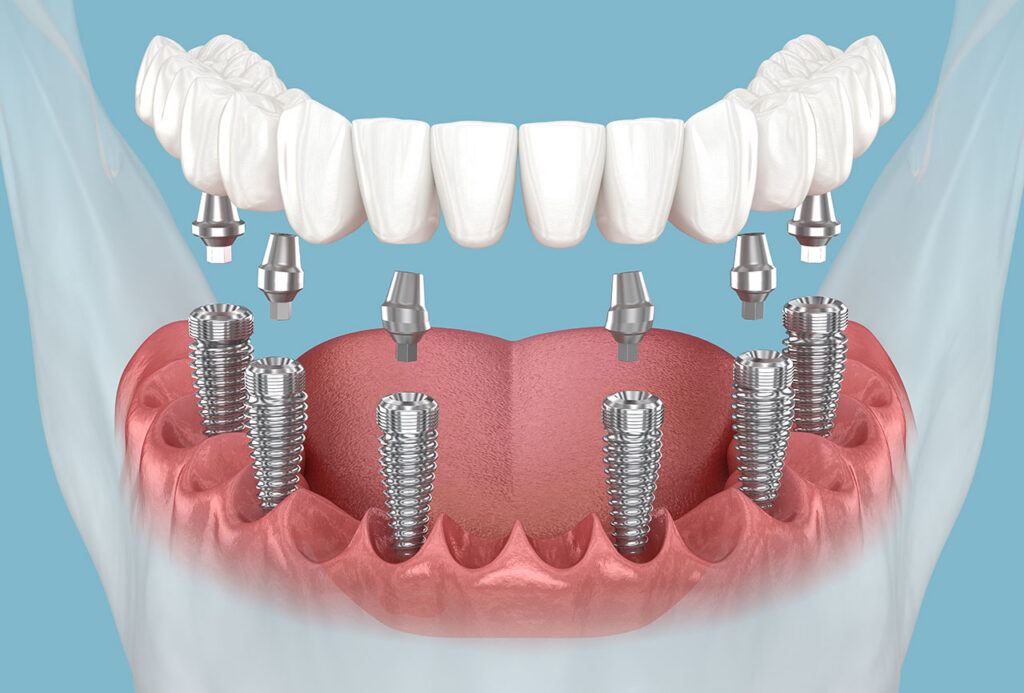
When most or all of the teeth in an upper or lower arch can no longer be predictably maintained, replacing each tooth individually is not the only option. Full-arch treatment can use strategically positioned dental implants to support a connected set of replacement teeth. This approach is often described as All-on-X implants, with the “X” referring to the number of implants selected for the individual treatment plan.
At MB Dental at Heights, patients exploring All-on-X implants can begin by learning about the practice’s existing dental implant options, including implant-supported and full-arch solutions. The number and position of implants should be based on each patient’s bone, anatomy, bite, existing teeth, and restorative needs rather than a fixed formula.
What Are All-on-X Implants?
All-on-X implants are a full-arch tooth replacement concept in which multiple dental implants support a fixed or highly stable restoration replacing a complete row of teeth.
The term does not refer to one universal number of implants. Instead, “X” represents the number selected for the individual case. Some full-arch plans may use four implants, while others may require a different number based on anatomy and restorative goals.
This is an important distinction because successful implant treatment depends on more than choosing a popular number. Bone availability, implant positioning, bite forces, restoration design, and long-term maintenance must all be considered.
For that reason, an All-on-X implant consultation should begin with diagnosis and planning rather than assuming the same approach will work for every patient.
Who Might Consider All-on-X Implants?
All-on-X implants are generally discussed with patients who need comprehensive tooth replacement across an entire dental arch.
Potential candidates may include people who:
- Are missing all teeth in an upper or lower arch
- Have multiple failing or severely damaged teeth
- Have extensive decay that makes many teeth difficult to restore
- Have advanced periodontal damage affecting numerous teeth
- Currently wear a traditional complete denture and want to explore implant-supported options
- Need a more comprehensive restorative plan rather than multiple isolated dental repairs
However, the fact that several teeth have problems does not automatically mean they need to be removed. A careful examination is necessary to determine which teeth can be predictably maintained and whether full-arch implant treatment is appropriate.
How Are All-on-X Implants Different From Individual Dental Implants?
A single dental implant usually replaces one missing tooth with an implant-supported crown. When a few neighboring teeth are missing, implants may also support a bridge.
All-on-X implants take a different approach. Instead of placing one implant for every missing tooth, a planned number of implants support a connected full-arch restoration.
This allows the implants to work together as the foundation for a larger prosthesis. Consequently, treatment planning involves the entire arch rather than focusing on one individual tooth.
The dentist must consider where implants can be positioned, how forces will be distributed, the shape of the final restoration, available restorative space, and how the patient will clean underneath and around the prosthesis.
What Happens During an All-on-X Implant Evaluation?
A full-arch implant consultation is more comprehensive than simply looking at the visible teeth. The dentist needs information about the teeth, gums, jawbone, bite, facial proportions, medical history, and treatment expectations.
Dental imaging and digital records may be used to evaluate the amount and location of available bone. In addition, the dentist assesses any remaining teeth to determine their condition and prognosis.
If All-on-X implants appear suitable, the next step is restorative planning. This includes determining the desired tooth positions, bite relationship, implant locations, and type of temporary or final restoration.
Patients should also discuss the expected treatment sequence, healing requirements, home-care routine, and long-term maintenance before moving forward.
The Role of Bone in Full-Arch Implant Treatment
Dental implants rely on surrounding bone for support. Therefore, the amount, quality, and location of jawbone are key parts of All-on-X implant planning.
One goal of strategic implant positioning is to make effective use of available bone. However, some patients may still require bone grafting or another preparatory procedure.
The upper and lower jaws also have different anatomical considerations. For example, the upper jaw is near the sinus cavities, while the lower jaw contains important nerves that must be considered during surgical planning.
Advanced imaging helps the dentist evaluate these structures and plan implant positions appropriately.
What Does the All-on-X Implant Process Involve?
Although every treatment plan is different, full-arch implant treatment generally includes several stages.
Comprehensive Planning
The dentist evaluates your current oral health and develops a plan for the teeth, implants, and restoration. If hopeless teeth are present, their removal may be incorporated into the surgical phase.
Implant Placement
The planned dental implants are placed into the jawbone. Their number and exact positions depend on the individual treatment design.
Temporary Teeth When Appropriate
In some cases, patients may receive a temporary full-arch restoration during the early phase of treatment. However, immediate temporary teeth depend on factors such as implant stability, bone condition, bite forces, and the dentist’s clinical assessment.
Therefore, patients should not assume that same-day fixed teeth are appropriate in every All-on-X implant case.
Healing and Integration
The implants need time to become stable within the surrounding bone. During this phase, patients receive instructions about diet, oral hygiene, and protecting the developing implant foundation.
Final Restoration
After appropriate healing, the final full-arch restoration can be created and connected to the implants. The dentist evaluates the bite, appearance, phonetics, and fit as part of this process.
Benefits of All-on-X Implants
For properly selected patients, All-on-X implants can offer several advantages as a full-arch tooth replacement strategy.
- Full-arch replacement: A connected restoration can replace an entire upper or lower row of teeth.
- Implant-based support: The restoration receives support from implants placed in the jaw rather than relying only on the gums.
- Improved stability: Implant support can reduce the movement commonly associated with conventional removable dentures.
- Functional chewing support: A stable full-arch restoration can improve the ability to chew compared with an unstable or poorly fitting removable appliance.
- Streamlined implant strategy: Full-arch treatment does not require placing an individual implant for every missing tooth.
- Customized planning: Implant number, position, and restoration design can be planned according to the patient’s anatomy and needs.
- Natural-looking tooth arrangement: The restoration can be designed to create balanced tooth size, shape, and alignment.
All-on-X Implants Versus Traditional Dentures
Traditional complete dentures replace an entire arch of teeth while resting primarily on the gum tissues. They remain an important tooth replacement option and may be appropriate for patients who do not want or cannot undergo implant treatment.
However, removable dentures can move during chewing and speaking, particularly when the fit changes as the jawbone changes over time.
All-on-X implants use dental implants to provide a more stable foundation for the replacement teeth. Depending on the restoration design, the prosthesis may be fixed in place by the dentist or may follow another implant-supported configuration.
The tradeoff is that implant treatment involves surgery, healing, more extensive planning, and ongoing maintenance around the implant components.
Therefore, the decision should be based on health, anatomy, expectations, maintenance ability, and individual preferences.
Can All-on-X Implants Be Completed in One Day?
Patients often encounter advertising about “teeth in a day.” In certain cases, implants and a temporary full-arch restoration may be placed during the same treatment phase.
However, this does not mean the entire biological healing process is completed in one day. The implants still require time to integrate with the jawbone, and a temporary restoration is not necessarily the same as the definitive final prosthesis.
Whether immediate loading is appropriate depends on implant stability, bone quality, treatment design, and other clinical factors.
Consequently, it is more useful to ask whether same-day temporary teeth are appropriate for your particular All-on-X implant plan rather than assuming they are guaranteed.
Eating During All-on-X Implant Healing
Diet is an important part of the healing period. Even when a temporary restoration is placed, the implants beneath it are still healing.
Your dentist may recommend a modified or softer diet for a period of time to limit excessive force on the implants. Following those instructions helps protect the surgical sites and developing implant stability.
As healing progresses, dietary recommendations may change. Your dental team can explain when different food textures can be reintroduced.
Trying to test the new teeth with very hard or chewy foods too soon is not recommended simply because the restoration feels stable.
How Do You Clean All-on-X Implants?
Full-arch implant restorations require daily cleaning. Although the replacement teeth themselves do not develop cavities, plaque can accumulate around the implants and along the gumline.
Depending on the design, cleaning may involve a soft toothbrush, specialized floss, interdental brushes, water irrigation devices, or other tools recommended by the dental team.
The area beneath a full-arch restoration also needs attention. Your dentist or hygienist can demonstrate how to access these spaces effectively.
Professional maintenance visits are equally important. These appointments allow the team to evaluate the implants, surrounding tissues, bite, prosthetic components, and areas that may be difficult to inspect at home.
Questions to Ask Before Choosing Full-Arch Implant Treatment
All-on-X implants are a significant dental treatment, so patients should feel comfortable asking detailed questions.
- Which of my existing teeth can be saved?
- How many implants are being recommended, and why?
- Do I have adequate bone for the planned implant positions?
- Will I need extractions or bone grafting?
- Will I receive temporary teeth during healing?
- What foods will I need to avoid during recovery?
- How will I clean under the full-arch restoration?
- What type of maintenance appointments will I need?
- What happens if an implant or prosthetic component develops a problem later?
A clear discussion of these questions helps patients understand both the advantages and responsibilities involved with All-on-X implants.
Frequently Asked Questions About All-on-X Implants
What does the X mean in All-on-X implants?
The X represents the number of implants selected to support the full-arch restoration. The appropriate number depends on the patient’s anatomy, bone, bite, and treatment design.
Are All-on-X implants the same as dentures?
Both can replace a full arch of teeth, but All-on-X treatment uses dental implants as the supporting foundation. Conventional dentures primarily rest on the gum tissues.
Does everyone receive temporary teeth immediately?
No. Immediate temporary teeth depend on implant stability, bone condition, treatment design, and other clinical factors.
Do All-on-X implants need to be cleaned?
Yes. Daily cleaning around the implants and beneath the restoration is important for maintaining healthy surrounding tissues.
How many implants will I need?
There is no single number that is right for everyone. The dentist determines the number and position of implants after evaluating bone, anatomy, restorative needs, and bite forces.
Explore a Personalized Full-Arch Treatment Plan
Full-arch tooth replacement is a major decision, and the best starting point is understanding what can be preserved, what needs to be replaced, and how the new teeth will be supported. All-on-X implants may provide an implant-supported option for patients facing extensive tooth loss, but careful planning is essential.
Contact MB Dental at Heights at (281) 857-6404 or Contact Us to Schedule a Consultation to discuss All-on-X implants and full-arch tooth replacement at 1111 Studewood St Suite C, Houston, TX 77008.